
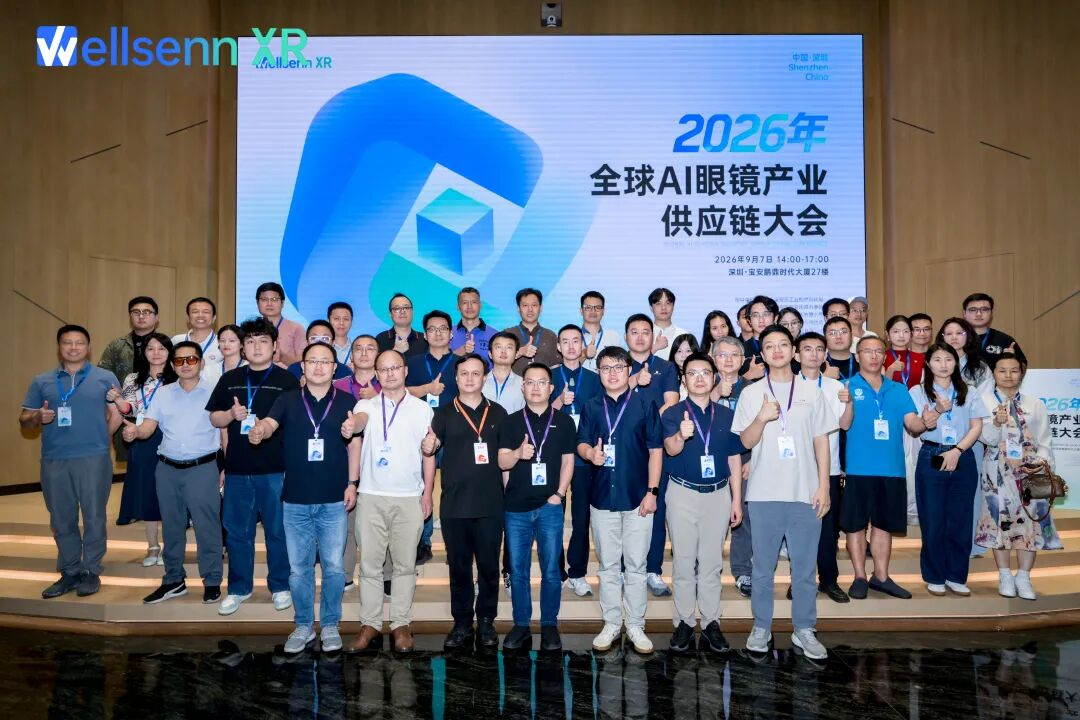
Exploring New Paths for AI Glasses Industry Commercialization — 2026 Global AI Glasses Industry Supply Chain Conference Successfully Held in Shenzhen
As a key pre-event of the CIOE (China International Optoelectronic Exposition) series, the 2026 Global AI Glasses Industry Supply Chain Conference was successfully held in Shenzhen on September 7.
This conference focused on the practical challenge of moving the AI glasses industry from technology prototypes toward large-scale mass production. It brought together leading enterprises and technical experts from across the entire industry chain — including chips, sensing and interaction, imaging algorithms, precision manufacturing, complete-device solutions, and peripheral ecosystems — to conduct in-depth discussions around industry pain points, build a high-end industry platform for supply-demand matching, technical exchange, and resource collaboration, and help drive the high-quality development of the AI glasses industry.

The venue also featured a product experience zone showcasing 15 of the industry's latest AI glasses products, including RayNeo io, Canaan K2, Ewing G2, moonix AI Glasses, and Meta Glasses. Attendees were able to observe and test these devices up close, directly experiencing the current hardware standards and real-world user experience of consumer-grade AI glasses, helping to drive the high-quality development of the AI glasses industry.

The conference was held under the guidance of the Shenzhen Bao'an District Industry and Information Technology Bureau and the Xin'an Sub-district Office of Bao'an District, Shenzhen. It was hosted by Shenzhen Wellsenn Information Technology Co., Ltd., and co-organized by the Shenzhen Augmented Reality Technology Application Association, Shenzhen Hengyue Maker Space Co., Ltd., and the Xin'an Sub-district Chamber of Commerce of Bao'an District, Shenzhen. Anchored in Shenzhen's well-developed electronics and information industry cluster, the event focused on the context of the AI glasses industry entering a "deep-water zone," directly confronting the technical bottlenecks and supply chain challenges in commercialization, consolidating industry consensus, and exploring cooperation opportunities.
Opening Speech — He Wancheng
He Wancheng, founder and general manager of the conference organizer Wellsenn, delivered the opening speech. Reviewing the industry's development, he noted that as early as August 2024, Wellsenn had held the industry's first dedicated AI smart glasses event, when the industry was still in the conceptual-exploration stage of product definition and solution demonstration. After two years of iteration, the market has successively introduced first- and second-generation consumer AI glasses products, and the industry has officially entered the deep-water zone.
"Currently, the industry still faces multiple practical challenges: insufficient diversification of chip solution supply; core technologies such as eye-tracking interaction and image processing that still require continuous refinement; and the ecosystem integration of AI glasses with various smart wearable devices that needs further deepening," He Wancheng pointed out. He added that the conference was held to listen to the real demands of every link in the industry chain and break down upstream-downstream information barriers, hoping that participating enterprises would leverage this platform to connect with quality suppliers, technical solutions, and industry customers, accelerate product commercialization, and jointly expand and strengthen the AI glasses industry.

Keynote Speeches — Six Industry Voices
During the keynote session, six enterprise representatives from key tracks across the industry chain took the stage in turn, sharing industrial practices and technical solutions covering chip hardware, sensing and interaction, imaging processing, flexible interconnection, complete-device ODM, and peripheral accessories, offering actionable references for the industry.

Combining market data analysis, Wei Ming, Global Marketing Director of Smart Wearables at Infineon, noted that the smart glasses and AR hardware market continues to grow at a high rate, while the VR terminal market is slowing down. He systematically introduced Infineon's four core hardware products already in mass production for AI glasses, including the PSoC Edge series AI MCU, the MultiSense PSOC 4000T touch controller, the Wi-Fi/Bluetooth combo wireless chip, and a series of digital microphones.
Addressing widespread industry pain points — weak support for the mass market, high core component costs, high standby power consumption of voice wake-up, and the difficulty of balancing power consumption, bandwidth, size, and RF coexistence in wireless communication — Infineon has launched an integrated software-and-hardware low-power system solution. The architecture enables the Wi-Fi subsystem to connect directly to the ISP, so image and video data streams no longer need to be forwarded through the MCU, eliminating the interface bandwidth bottleneck. Bluetooth and Wi-Fi RF coexistence optimization is completed inside the chip, reducing the difficulty of whole-device tuning. Leveraging its self-developed NNlite NPU core, paired with analog microphones, the solution achieves ultra-low-power voice activity detection, with standby power consumption as low as 1.4 mW in high-noise environments. The entire system is highly compatible and can adapt to multiple mainstream ISP vendors, effectively shortening customers' product development cycles. Wei Ming also revealed that the company plans to launch a next-generation Wi-Fi 7 chip in 2027 to further reduce wireless transmission power consumption and improve throughput performance.

Chen Keqing, founder and CEO of Jihao Technology, shared under the theme "Eye-Tracking — The Key to Future AI Applications." Starting from the layered logic of the AI industry, and based on the different sources of context, he divided AI applications into three categories: "no context," "accessing context," and "producing context," and put forward a core viewpoint: AI glasses are a typical AI terminal that can continuously "produce" context from the user's perspective, enabling the device to "see what you see and hear what you hear."
Chen Keqing stated that while continuous audio sensing technology is already maturing, the all-day recording of first-person visual information still faces enormous pressure. Based on the human eye's 220°×135° field of view and 60 PPD retinal resolution, the raw video data volume is massive, making complete storage impractical. Drawing on the biological characteristics of the human eye — which has high resolution in the foveal region and acquires fine information during gaze — eye-tracking technology can turn the human eye's selection into the sampling basis for AI glasses. By capturing the gaze region at high fidelity, compressing data from non-focused regions, and filtering out ineffective periods of saccadic eye movement, the data volume can be dramatically reduced. Sampling by fixation points, the effective visual information generated from 12 hours of wear can be compressed to 1.5 GB, greatly reducing storage, transmission, and computing pressure.
He also emphasized that eye-tracking is the core interaction gateway of next-generation AI glasses, but beyond technical implementation, the industry urgently needs to jointly establish consensus on data authorization, privacy protection, and the boundaries of information recording, to promote compliant and healthy technological development. Jihao Technology is a supplier of integrated sensing and interaction solutions for smart terminals, with a self-developed pure-AI-algorithm eye-tracking interaction solution, and is simultaneously developing gesture interaction and lip-motion interaction solutions, providing diversified sensing and interaction capabilities for AI glasses.

Zhang Yan, founder and CEO of Superpixel Technology, focused on the engineering implementation of AI glasses imaging systems. Constrained by size, weight, and battery life, AI glasses camera hardware inherently involves "downgraded" specifications and cannot replicate the large-sensor, optical-image-stabilization hardware of smartphones, directly causing common industry problems such as noticeable image shake, poor low-light image quality, and low capture success rates in motion scenes. To address these pain points, Superpixel Technology has launched a full-stack intelligent imaging engine covering five algorithm engines — image quality, video quality, portrait enhancement, image recognition, and multi-camera — along with complete software ISP development capabilities.
Zhang Yan introduced the industry's mainstream glasses-phone split imaging processing architecture: the glasses side handles only lightweight preprocessing such as scene judgment, multi-frame sampling, and IMU timestamp alignment, then transmits the raw data to the phone side for high-compute operations such as HDR, multi-frame noise reduction, distortion correction, and video stabilization. For on-device local processing needs, the company has introduced an ultra-fast HDR algorithm that, with GPU hardware acceleration, reduces computation time to 200–500 ms, already achieved in mass production on mobile phones and equally adaptable to AI glasses hardware platforms. For high-frequency, high-amplitude vibration scenarios such as cycling and outdoor sports, sub-millisecond IMU and camera calibration alignment significantly improves the stability of on-device video stabilization, effectively solving the blurry-footage problem in motion capture.
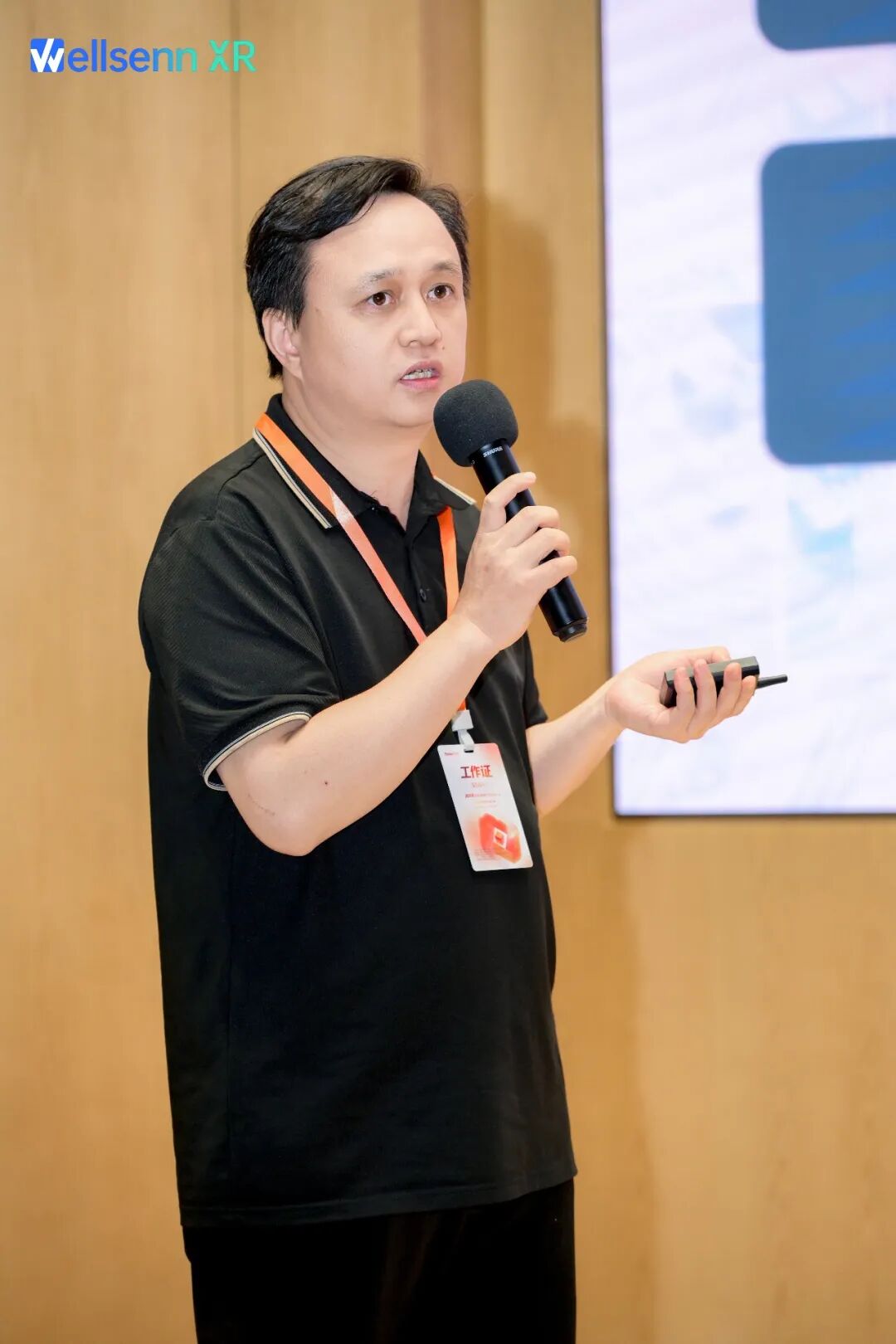
Zhu Wan, chief engineer of the R&D center at Zecheng Electronics, delivered a special presentation on the mass-production challenges of high-density flexible printed circuits (FPC) for AI glasses. The industry has reached a consensus that AI glasses are rapidly evolving toward 50g and even 35g lightweight designs; while whole-device functionality keeps stacking up, the physical space of the temple arms and front frame keeps shrinking, making high-density FPC the "neural network" for whole-device interconnection in AI glasses.
Zhu Wan emphasized that FPC for AI glasses cannot follow the traditional post-hoc development model of consumer electronics, where circuit-board design begins only after the structural parts are fully finalized. FPC solutions must be involved at the early stages of prototyping and mold opening, simultaneously evaluating key indicators such as circuit stacking, line width and spacing, hinge bending life, and high-speed signal transmission. Post-hoc development can easily lead to broken traces at bends, low yield, and repeated board revisions, lengthening the development cycle and increasing mass-production costs. Zecheng Electronics can provide one-stop services covering early collaborative design, board fabrication, and SMT, with the capability for 27-layer high-order FPC mass production, and is simultaneously laying out FC and SiP system-in-package technologies to provide hardware support for the next generation of high-density, miniaturized AI glasses.

Jiang Gaoping, general manager of Yitian Technology, delivered the keynote report "The Road from AR Glasses Solutions to Mass Production: Integrated Whole-Device OEM/ODM Solutions." With years of deep experience in the XR industry, Yitian Technology has built an AI glasses reference platform based on the dual-chip collaborative architecture of the Hengxuan BES2800 and Sigmastar 309L, focusing on core engineering challenges such as power consumption management, audio processing, ISP image processing, and on-device AI inference. The team has complete XR project implementation experience and a deep command of the mass-production pain points in AI glasses hardware structure, FPC interconnection, and audio tuning, helping customers avoid common pitfalls in R&D, while also connecting with third-party algorithm partners in audio and imaging for joint adaptation.
The company focuses on an ODM/OEM whole-device delivery model, where customers provide the product requirement document (PRD) and ID design, and Yitian completes the entire engineering process covering hardware development, software drivers, whole-device validation, and supply chain implementation. In response to the difficulty of directly reusing industry reference solutions, the company offers a complete SDK and API interface to support rapid secondary development by customers, meeting the customization needs of B-end and domestic and international customers. At the same time, the company is advancing the R&D of full-color optical waveguide prototypes and eye-tracking versions, with plans to release them successively starting in 2027.

Chen Ping, deputy general manager of Yongxin Technology, delivered an in-depth analysis of the seamless interaction ecosystem between smart rings and AI glasses. He offered an industry judgment: AI glasses are expected to become the next-generation super smart terminal, and smart rings have great potential to become its super interaction gateway. Reviewing the iteration cycles of consumer electronics, PCs, smartphones, and earphones/watches have each completed their industrial cycle in turn; AI glasses and smart rings are seen as two emerging categories with the potential to reach 100-million-unit shipment scale over the next decade.
Comparing neural-band solutions, Chen Ping noted that besides serving glasses interaction, smart rings can also independently realize diverse scenarios such as health monitoring, TV voice remote control, and NFC mobile payment, giving them independent product value. However, smart rings have long faced an "impossible triangle" of size, functionality, and mass-production yield; SiP system-in-package technology can integrate dozens of components at high density, reduce PCB routing difficulty, and effectively improve mass-production yield. Yongxin Technology has delivered multiple mature SiP packaging solutions, outputting standardized reference designs to the industry. He also proposed that the SiP packaging approach is equally applicable to AI glasses complete devices: through system-in-package integration, whole-device weight reduction, narrower temple arms, and functional upgrades can be achieved, and the future market will see more AI glasses terminal products adopting SiP solutions.
Closing & Outlook
After all keynote speeches concluded, the conference organized all speakers to take a group photo on stage. This was followed by a free networking and exchange session, where participating brands, R&D institutions, and supply chain vendors engaged in face-to-face in-depth communication on chip selection, algorithm porting, supply chain manufacturing, and product definition, seeking business cooperation opportunities.
The conference presented a complete and realistic picture of the current AI glasses industry: the industry has moved beyond pure concept hype, with various technical solutions continuing to iterate, but still faces a large number of pressing topics in power consumption control, lightweight design, new interaction experiences, mass-production yield, and cost control. The large-scale commercial implementation of AI glasses cannot be achieved by any single enterprise alone; it requires collaborative innovation across the entire chain of chips, algorithms, optics, precision hardware, and peripheral ecosystems. In the future, as the upstream and downstream of the industry chain continue to refine technologies and improve the supply chain system, AI glasses are expected to truly become the next-generation personal smart terminal after smartphones, building a brand-new human-computer interaction paradigm.